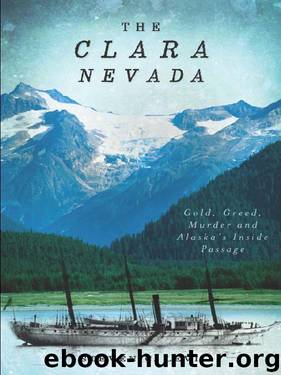
The Clara Nevada: Gold, Greed, Murder and Alaska's Inside Passage by Steven C. Levi
Author:Steven C. Levi [Levi, Steven C.]
Language: eng
Format: epub
Publisher: Arcadia Publishing
Published: 2019-04-30T16:00:00+00:00
Chapter 7
The End of the Maritime Frontier
Perhaps the ultimate irony of C.H. Lewis’s life was the beaching of the William H. Evans. Here he was, at the top of his profession in his peak earning years, the captain and owner of his own vessel, midstream in one of the greatest gold rushes in the history of mankind, a stampede that depended primarily upon water transportation—and fate had left him sitting high and dry while a flood of steamships passed him going upriver. No doubt he realized that every morning he didn’t travel, he was losing $500 in income—$14,000 today.
But it was also ironic. In the decades between 1880 and 1900, he had skippered five ships, the Pilot’s Bride, San Vincente, Eugene, Clara Nevada and the William H. Evans. Of these, two had been beached, two burned and one sunk. Only the Eugene remained above water when Lewis’s tenure as captain was through, but it had bankrupted its owners and come close to turning turtle as well. Examining his record, one would be hard pressed to call Lewis a competent skipper or successful businessman.
Being responsible for that many ships that met disaster hardly looked good on one’s record. Other captains who had done far less were punished far more severely than Lewis ever was. In February 1899, for instance, Captain Jessen of the Homer had his license suspended for thirty days. Jessen’s transgression was backing into the steamer Al-Ki at a very low speed. Total damage was about $3,000. This was not even pocket change compared to the damage of the Clara Nevada, not to mention loss of life.
But times were changing. Though Lewis may not have known it at the time, the William H. Evans and the rest of the gold rush fleet was doomed. The end of their era was rapidly approaching in two forms.
The first was a railroad: the White Pass & Yukon Railroad, “the road that couldn’t be built.” An organizational hybrid, it was actually three railroads, one incorporated in the United States, another in British Columbia and a third in the Yukon. The first passengers went over White Pass in February 1899, and the first through passengers to Lake Bennet made it in July of that year. By the time Lewis resolved his legal difficulties, the Yukon River route was defunct. It was cheaper to go by steamer to Skagway and then rail. As of August 1899, trains ran regularly between Skagway and White Horse.
The second blow was the Nome gold rush. On May 6, 1899, the Post-Intelligencer ran a small filler, telling “of a marvelously rich gold discovery at Cape Nome, halfway between Golovin Bay and Bering Strait, near the entrance of Norton Sound.” Suddenly the attention of the world was focused on the golden beaches of Nome on the Bering Sea. Overnight, the Klondike in Canada’s Interior lost its luster. In October, the Post-Intelligencer reported that Dawson was emptying, as much of its population joined in the rush to Nome. So many were leaving, reported some stampeders, that “men are getting scarce in the Klondike metropolis.
Download
This site does not store any files on its server. We only index and link to content provided by other sites. Please contact the content providers to delete copyright contents if any and email us, we'll remove relevant links or contents immediately.
Whiskies Galore by Ian Buxton(42168)
Introduction to Aircraft Design (Cambridge Aerospace Series) by John P. Fielding(33250)
Small Unmanned Fixed-wing Aircraft Design by Andrew J. Keane Andras Sobester James P. Scanlan & András Sóbester & James P. Scanlan(32879)
Aircraft Design of WWII: A Sketchbook by Lockheed Aircraft Corporation(32385)
Craft Beer for the Homebrewer by Michael Agnew(18357)
Turbulence by E. J. Noyes(8219)
The Complete Stick Figure Physics Tutorials by Allen Sarah(7485)
The Institute by Stephen King(7163)
The Thirst by Nesbo Jo(7111)
Kaplan MCAT General Chemistry Review by Kaplan(7057)
Bad Blood by John Carreyrou(6741)
Modelling of Convective Heat and Mass Transfer in Rotating Flows by Igor V. Shevchuk(6594)
Weapons of Math Destruction by Cathy O'Neil(6480)
Learning SQL by Alan Beaulieu(6406)
Man-made Catastrophes and Risk Information Concealment by Dmitry Chernov & Didier Sornette(6229)
Permanent Record by Edward Snowden(5965)
Digital Minimalism by Cal Newport;(5938)
Life 3.0: Being Human in the Age of Artificial Intelligence by Tegmark Max(5689)
iGen by Jean M. Twenge(5518)
